One of the first questions founders ask is simple: how much will our MVP cost? The honest answer is that it depends on scope, but you can still plan with realistic ranges and clear priorities.
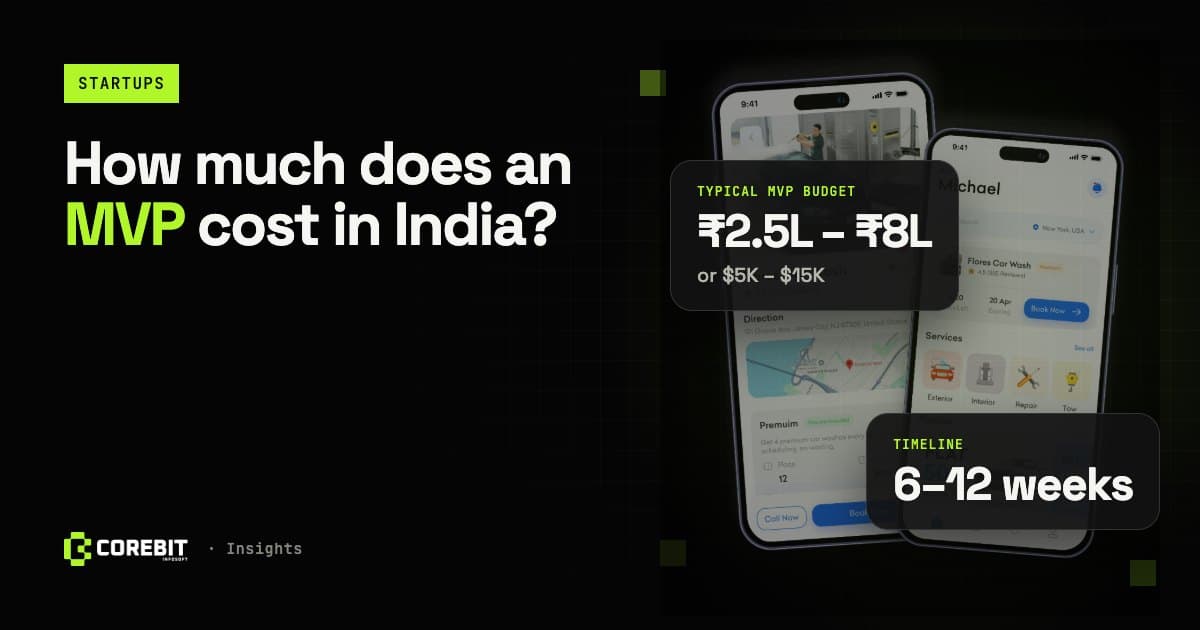
At Corebit Infosoft, most MVP engagements fall between ₹2.5L and ₹8L (roughly $5K–$15K), depending on whether you need mobile, web or both, and how complex your core flows are.
What is an MVP, exactly?
A minimum viable product is the smallest version of your product that real users can use and that proves (or disproves) your core idea. It is not a prototype or a demo: it is live, usable software, just with a deliberately small feature set.
What drives MVP cost?
1. Platform choice
A single cross-platform app built with Flutter or React Native is usually more efficient than building separate iOS and Android apps. A marketing website plus a simple web app costs less than a full marketplace with payments and chat. Not sure which to pick? Read Flutter vs React Native.
2. Features, not screens
Login, profiles, listings, payments, notifications, admin panels and third-party integrations each add scope. The best MVPs include only what is needed to test your core idea.
3. Design depth
Wireframes and a clean, usable interface are essential. Pixel-perfect marketing pages and complex animations can wait for version two.
4. Engagement model
Fixed-scope MVPs have predictable pricing. A dedicated monthly team suits products that change every week. Pick the model that fits how clear your requirements are.
Typical cost ranges
- Simple MVP (one platform, one or two user flows, basic admin): around ₹2.5L–₹4L / $5K–$7K.
- Standard MVP (mobile app plus web admin, payments, notifications): around ₹4L–₹6L / $7K–$11K.
- Advanced MVP (multiple user roles, marketplace, chat, integrations): around ₹6L–₹8L+ / $11K–$15K+.
These are planning ranges, not quotes. A short discovery call is the fastest way to get an accurate number for your idea.
Typical MVP timelines
A focused MVP with one or two core user flows often ships in 6–12 weeks. Products with payments, multiple user roles or heavy integrations may need 14–20 weeks.
- Discovery: 1–2 weeks
- Design: 2–3 weeks
- Development: 4–8 weeks
- Testing and launch: 1–2 weeks
How to reduce cost without hurting quality
- Start with one platform or one main user role. Add the rest once users prove demand.
- Use proven backends like Firebase or a lean Node.js API instead of over-engineering on day one.
- Write a one-page product brief: the problem, the user, how you will measure success, and the must-have features. Cut everything else from version one.
- Work with a team that has shipped MVPs before. Rework caused by unclear scope costs far more than good planning upfront.
Hidden costs to plan for
Budget for app store fees, hosting, third-party services (maps, SMS, payments) and post-launch maintenance. A good partner will list these in the quote so there are no surprises.
Frequently asked questions
Is it cheaper to build an MVP in India?
For many founders, yes. Indian teams often offer strong quality at a lower cost than agencies in the US or Europe. What matters most is the team's experience, communication and process, not just the hourly rate.
Can I start with a smaller budget?
Yes. Many founders start with a clickable prototype or a single-platform MVP, then expand once they have users or funding.
Next steps
If you are planning an MVP, share your idea and target timeline. We will help you define a realistic first version and give you a transparent estimate, with no obligation. Learn more about our web, SaaS and MVP development and mobile app development services, or get a free quote.